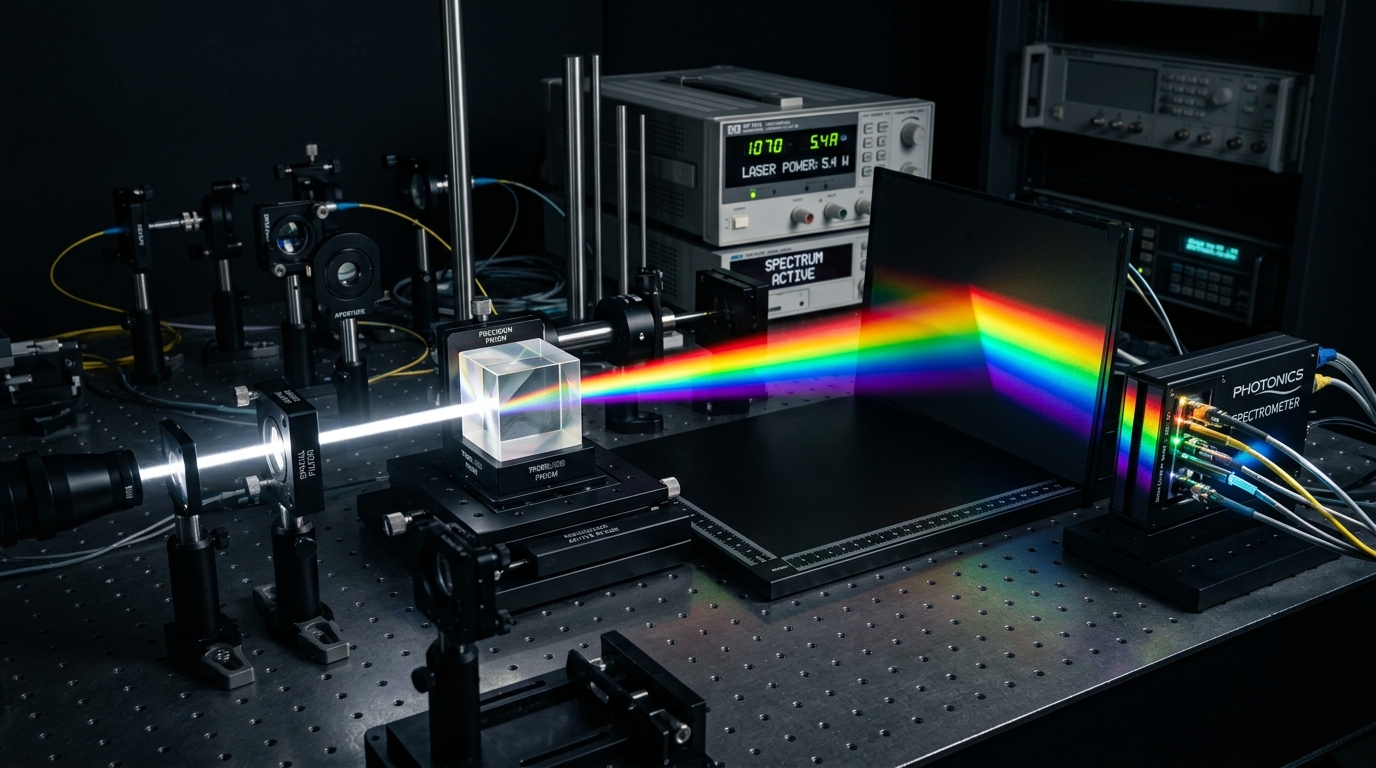
Frequency metrology quantifies the occurrence rate of periodic physical oscillations per unit time. The SI unit is the Hertz (1 Hz = 1 cycle/s). In electromagnetic propagation, frequency (f) and wavelength (λ) are linked through the speed of light by the exact relationship c = λ · f, where c = 299,792,458 m/s.
1 Hz = 1 cycle/s; 1 kHz = 10^3 Hz; 1 MHz = 10^6 Hz; 1 GHz = 10^9 Hz; 1 THz = 10^12 Hz; speed of light c = 299,792,458 m/s; Caesium transition Δν_Cs = 9,192,631,770 Hz (exact); Planck constant h = 6.62607015 × 10^-34 J·s.
Key Takeaways & Core Facts
Essential metrology takeaways synthesized for researchers, engineers, and technical professionals.
The SI second is defined by fixing the unperturbed ground-state hyperfine transition frequency of the Caesium-133 atom at exactly 9,192,631,770 Hz.
Optical frequency combs generate millions of evenly spaced laser lines, bridging microwave atomic standards to optical frequencies with uncertainties below 10^-18.
Doubling frequency halves the physical wavelength, meaning a 300 MHz signal has a 1-meter wavelength while a 30 GHz millimeter wave measures just 10 millimeters.
Quartz crystal oscillators undergo thermal frequency drift, requiring temperature-compensated (TCXO) or oven-controlled (OCXO) stabilization circuits for precision RF synthesizers.

Periodic Oscillations and the Quantum Definition of the Second
Frequency quantifies the occurrence rate of recurring cyclic physical events per unit of elapsed time ($f = 1/T$, where $T$ represents the period duration). In the International System of Units, frequency possesses the coherent derived unit of the Hertz (Hz), established in 1930 to commemorate German physicist Heinrich Hertz who first conclusively proved the existence of electromagnetic waves. One Hertz equals exactly one complete periodic oscillation cycle per second ($1\text{ Hz} = 1\text{ s}^{-1}$).
Because time and frequency can be realized with higher physical precision than any other physical dimension, modern metrology anchors multiple fundamental constants directly to atomic frequency standards. The SI base unit of time—the second—is defined by fixing the unperturbed ground-state hyperfine transition frequency of the Caesium-133 atom ($\Delta\nu_{\text{Cs}}$) at exactly 9,192,631,770 Hertz. Radio frequency engineers and laboratory physicists utilize the verified frequency and wavelength converter to translate gigahertz, megahertz, optical nanometers, and photon energy levels across high-frequency circuit layouts.
The Reciprocal Physics of Frequency and Wavelength
Electromagnetic radiation propagates through free space at the fixed, invariant velocity of light in a vacuum ($c = 299,792,458\text{ meters per second}$). Within this electromagnetic continuum, frequency ($f$) and physical wavelength ($\lambda$) maintain an exact reciprocal relationship: $c = \lambda \cdot f$. As an oscillation frequency climbs higher, the physical distance between consecutive wave peaks compresses proportionally.
An amplitude-modulated (AM) radio station broadcasting at 1,000 kilohertz ($1\text{ MHz}$) transmits electromagnetic waves possessing a wavelength of approximately 300 meters, requiring towering broadcast transmission masts. A 5G cellular transceiver operating at 28 Gigahertz millimeter-wave frequencies transmits waves measuring roughly 10.7 millimeters, enabling phased-array micro-patch antennas to be embedded directly into smartphone circuit boards. Telecommunications systems model carrier propagation latencies using time interval metrology tools.
Primary Frequency Standards: Caesium Fountain Clocks
National primary frequency laboratories—such as NIST in Boulder, Colorado, and the PTB in Braunschweig, Germany—maintain primary atomic frequency standards that steer International Atomic Time (TAI) and Coordinated Universal Time (UTC). Modern primary standards deploy laser-cooled Caesium fountain clocks. Optical lasers trap clouds of millions of Caesium-133 atoms, cooling them to microkelvin temperatures just above absolute zero to eliminate thermal Doppler velocity broadening.
The fountain clock tosses the cold atom cloud vertically upward inside a high-vacuum chamber, allowing the atoms to pass twice through a low-loss microwave interrogation cavity under Earth's gentle gravitational arc. Applying Norman Ramsey's separated oscillatory field technique yields narrow quantum resonance fringes, achieving fractional frequency uncertainties below $1 \times 10^{-16}$. This staggering precision corresponds to a clock error of less than one single second over three hundred million years. For thermodynamic principles governing cryogenic gas laser cooling, explore our thermodynamic temperature scales paper.
Optical Clocks and Frequency Comb Metrology
While microwave Caesium standards define the current SI second, optical atomic clocks operating at hundreds of terahertz achieve stability two orders of magnitude higher. Optical lattice clocks trap strontium or ytterbium atoms inside standing-wave optical interference lattices formed by intersecting laser beams. Because optical frequencies oscillate roughly 100,000 times faster than microwave frequencies (approx. $430\text{ THz}$ versus $9.2\text{ GHz}$), optical clocks subdivide time into far finer temporal increments.
Bridging these ultrafast optical oscillations to readable electronic microwave counters long presented an insurmountable barrier until John Hall and Theodor Hänsch invented the optical frequency comb, recognized with the 2005 Nobel Prize in Physics. A mode-locked femtosecond laser emits an optical spectrum of millions of perfectly phase-locked, evenly spaced spectral lines resembling the teeth of a mechanical hair comb. The frequency comb acts as a precision optical-to-microwave gear train, counting terahertz optical cycles down to gigahertz electronic pulses without adding measurable phase jitter.
Quartz Crystal Resonators and Oscillator Stability
While atomic fountains anchor national metrology networks, commercial electronics rely on piezoelectric quartz crystal oscillators. Jacques and Pierre Curie discovered the piezoelectric effect in 1880: applying mechanical stress across certain anisotropic crystals produces an electrical charge, while applying an alternating voltage across the crystal induces mechanical vibration. Precision synthetic quartz wafers cut along specific crystallographic angles (such as the AT-cut) vibrate at stable resonant frequencies ranging from 32.768 kilohertz up to hundreds of megahertz.
Uncompensated quartz oscillators experience thermal frequency drift caused by crystal lattice expansion. High-stability frequency synthesizers deploy Temperature-Compensated Crystal Oscillators (TCXO) that utilize thermistor networks to apply corrective tuning voltages to a varactor diode. Demanding telecommunications cellular base stations employ Oven-Controlled Crystal Oscillators (OCXO), enclosing the quartz crystal and buffer circuitry inside a miniature, thermally insulated oven heated to a constant internal temperature above 75 degrees Celsius.
Frequency and Wavelength Conversion Reference Matrix
RF design engineers and telecommunications spectrum planners require exact conversion multipliers to coordinate frequency allocations across the electromagnetic continuum. The following reference table outlines standard conversions linking radio, microwave, optical, and terahertz bands:
| Frequency Band | Nominal Frequency ($f$) | Free Space Wavelength ($\lambda$) | Photon Energy ($E = hf$) | Representative Application |
|---|---|---|---|---|
| Very Low Frequency (VLF) | 30 kHz ($3 \times 10^4\text{ Hz}$) | 10 Kilometers (km) | $1.24 \times 10^{-10}$ eV | Submarine underwater navigation |
| High Frequency (HF) | 10 MHz ($10^7\text{ Hz}$) | 30 Meters (m) | $4.14 \times 10^{-8}$ eV | Over-the-horizon shortwave radio |
| Ultra High Frequency (UHF) | 1 GHz ($10^9\text{ Hz}$) | 300 Millimeters (mm) | $4.14 \times 10^{-6}$ eV | GPS L1 and commercial mobile cellular |
| Super High Frequency (SHF) | 10 GHz ($10^{10}\text{ Hz}$) | 30 Millimeters (mm) | $4.14 \times 10^{-5}$ eV | Automotive collision avoidance radar |
| Extremely High Frequency (EHF) | 60 GHz ($6 \times 10^{10}\text{ Hz}$) | 5 Millimeters (mm) | $2.48 \times 10^{-4}$ eV | High-bandwidth short-range wireless LAN |
| Terahertz Regime (THz) | 1 THz ($10^{12}\text{ Hz}$) | 300 Micrometers (μm) | 4.14 Milliev (meV) | Non-destructive spectroscopic imaging |
| Near Infrared Optical (NIR) | 193.1 THz (1,550 nm) | 1.550 Micrometers (μm) | 0.800 Electronvolts (eV) | DWDM long-haul optical fiber communications |
Allan Deviation: Characterizing Oscillator Noise and Drift
Evaluating the performance of precision frequency oscillators requires statistical metrics that separate random short-term noise from long-term systematic frequency aging. Traditional standard deviation fails when analyzing frequency sources because low-frequency flicker noise and environmental thermal drifts diverge mathematically over extended observation intervals.
In 1966, David W. Allan formulated the two-sample Allan variance, now standardized under IEEE 1139. Allan deviation ($\sigma_y(\tau)$) measures the root-mean-square difference between consecutive fractional frequency averages sampled over an integration time interval ($\tau$). Plotting Allan deviation on logarithmic axes allows metrologists to identify distinct noise processes: white phase noise ($\tau^{-1}$ slope), white frequency noise ($\tau^{-1/2}$ slope), flicker frequency noise (horizontal slope), and linear frequency drift ($\tau^{+1}$ slope). High-capacity networks utilize telecommunications data throughput tools to coordinate clock synchronization across synchronous Ethernet nodes.
Microwave Waveguide Propagation and Cutoff Frequency
At microwave frequencies above three gigahertz, coaxial copper cables suffer from intense dielectric losses and high-frequency conductor skin effect resistance, where alternating electrical current concentrates entirely within a sub-micron surface layer along the conductor perimeter. Microwave radar transmitters route high-power signals through hollow rectangular metal waveguides.
A hollow waveguide does not support a transverse electromagnetic (TEM) mode; instead, electromagnetic fields propagate through transverse electric (TE) or transverse magnetic (TM) modes. Every rectangular waveguide geometry possesses a distinct lower cutoff frequency ($f_c$), below which electromagnetic waves cannot propagate and are severely attenuated: $f_{c,10} = \frac{c}{2a}$, where $a$ represents the broad internal width dimension of the waveguide. Signals with frequencies below the cutoff frequency cannot pass through the hollow pipe. For radar signal velocity and Doppler shift equations, consult our aerodynamic velocity and radar guide.
Spectrum Coordination and Electromagnetic Compatibility
The electromagnetic radio spectrum represents a finite, sovereign natural resource managed globally by the International Telecommunication Union (ITU) under international treaty Radio Regulations. Spectrum management prevents mutual harmful interference between competing services, including weather satellite radiometers, aeronautical radionavigation, amateur radio, and commercial 5G cellular operators.
Electromagnetic Compatibility (EMC) testing verifies that commercial electronic products do not radiate unintended high-frequency spectral emissions that disrupt communications, while verifying that the equipment withstands external radio frequency electromagnetic fields under IEC 61000 standards. Rigorous frequency metrology ensures that billions of wireless devices transmit harmoniously across densely populated frequency bands, powering modern telecommunications and scientific discovery. For network bandwidth standards and transmission protocols, explore our network bandwidth metrology guide.
Authoritative Metrological Standards Cited
All unit ratios, physical constants, and dimensional formulas in this paper are verified against official international standards repositories.