Volume metrology measures three-dimensional space occupied by fluids or solids, anchored to the cubic meter (m^3) in the SI system. One US liquid gallon equals exactly 3.785411784 liters (231 cubic inches), whereas the British imperial gallon equals 4.54609 liters.
1 US liquid gal = 3.785411784 L (231 cu in); 1 UK Imperial gal = 4.54609 L; 1 US fl oz = 29.5735295625 mL; 1 UK fl oz = 28.4130625 mL; 1 m^3 = 1,000 L = 35.3147 cu ft; 1 US cup = 236.588 mL.
Key Takeaways & Core Facts
Essential metrology takeaways synthesized for researchers, engineers, and technical professionals.
The US liquid gallon (3.785 L) is approximately 16.7% smaller than the UK imperial gallon (4.546 L), causing frequent trans-Atlantic recipe and logistics errors.
Class A volumetric flasks and pipettes are calibrated to TD ("To Deliver") or TC ("To Contain") specifications within strict tolerances at 20°C.
Parallax error in meniscus reading can introduce measurement errors exceeding 1.5% in narrow-neck glassware.
Gravimetric calibration calculates fluid volume by weighing dispensed distilled water on an analytical balance and dividing by water's temperature-adjusted density.
Three-Dimensional Capacity and SI Geometric Derivations
Volume quantifies the three-dimensional extent occupied by a gas, liquid, or solid matrix. Within the International System of Units, volume is a derived geometric quantity anchored directly to the base meter, with one cubic meter representing the volume enclosed by a cube possessing edge lengths of exactly one meter. Because a cubic meter represents an unwieldy volume for chemical laboratories and pharmaceutical compounding, the 1964 Conférence Générale des Poids et Mesures sanctioned the liter as a special name for one cubic decimeter (0.001 cubic meters).
Modern process industries and food scientists operate across both metric cubic dimensions and customary liquid capacities. Converting complex fluid volumes between domestic packaging units and international shipping containers requires mathematical fidelity. Technicians frequently employ the certified volume conversion matrix to transition between liters, gallons, fluid ounces, and cubic centimeters without accumulating rounding variances across supply chain databases.
The Transatlantic Divergence: US Customary versus Imperial Gallons
Few measurement discrepancies generate more industrial confusion than the divergence between American and British liquid measures. The United States preserved the historic English Wine Gallon adopted during the reign of Queen Anne in 1707, standardizing the US liquid gallon at exactly 231 cubic inches (approximately 3.78541 liters). This gallon subdivides into four liquid quarts, eight liquid pints, and 128 US fluid ounces of 29.5735 milliliters each.
The British Empire reformed its weights and measures under the British Weights and Measures Act of 1824, abolishing historical wine and ale gallons in favor of a single Imperial Gallon. The British imperial gallon was defined as the volume of 10 avoirdupois pounds of distilled water weighed in air with brass weights at 62 degrees Fahrenheit, equaling approximately 4.54609 liters. Consequently, an imperial gallon is approximately 20.1 percent larger than a US liquid gallon, while a British fluid ounce (28.413 mL) is slightly smaller than its American counterpart.
Volumetric Glassware Classifications: Class A versus Class B
Analytical laboratories rely on specialized borosilicate glassware engineered to maintain volumetric stability across chemical heating and washing cycles. The American Society for Testing and Materials (ASTM E288) and ISO standards establish two distinct manufacturing tiers: Class A and Class B. Class A glassware is fabricated from thermal-shock resistant borosilicate glass and calibrated to tight volumetric tolerances, making it mandatory for certified testing.
Class B volumetric apparatus permits double the volumetric tolerance limit of Class A and is designated for general educational and non-regulatory applications. A certified 1,000-milliliter Class A volumetric flask holds a maximum permissible error of only plus or minus 0.30 milliliters at 20 degrees Celsius. Maintaining traceable compliance requires inspecting glassware for etched calibration markings indicating certified accuracy and batch serialization numbers.
To Contain versus To Deliver Designations
Volumetric vessels feature standardized inscriptions indicating their calibrated fluid interaction mode: TC ("To Contain", also designated In) or TD ("To Deliver", also designated Ex). Volumetric flasks and graduated mixing cylinders are manufactured as TC instruments, calibrated so that the internal fluid volume precisely matches the nominal capacity when filled to the graduation line. Residual fluid adhering to internal glass walls upon emptying does not affect containment accuracy.
Transfer pipettes, volumetric pipettes, and automatic burettes are calibrated as TD instruments. Their dimensional markings account explicitly for the wetting film and capillary meniscus residue that inevitably clings to inner glass surfaces after gravity drainage. Operators must never blow out the small droplet remaining in a volumetric transfer pipette tip unless that pipette is explicitly engraved with a frosted ground band indicating blow-out design.
Meniscus Reading Dynamics and Parallax Mitigation
Surface tension forces cause aqueous fluids in cylindrical glass tubes to form a curved interface known as the meniscus. In water and polar solvents, adhesive forces between liquid molecules and glass exceed cohesive intermolecular forces, pulling the liquid upward along the wall to create a concave meniscus. Accurate volumetric determinations require positioning the eye along the exact horizontal plane aligned with the lowest point of the concave curve.
Viewing the graduation mark from above or below introduces parallax error, projecting the bottom of the meniscus against false graduation levels. In a 50-milliliter burette, viewing the meniscus from an elevation angle of only five degrees skews titrant delivery calculations by up to 0.08 milliliters. Technicians employ black-and-white meniscus reading cards positioned immediately behind the glassware neck to cast a sharp optical reflection that eliminates reading ambiguity.
Gravimetric Pipette Calibration under ISO 8655
Mechanical air-displacement pipettes serve as the primary liquid-handling tools in molecular biology and pharmaceutical testing. Because mechanical piston seals experience frictional wear and micro-leakage over continuous pipetting cycles, ISO 8655-2 mandates periodic gravimetric performance verification. Technicians aspirate and dispense degassed, deionized water onto an analytical balance housed inside a humidity-controlled evaporation trap.
The balance records the delivered liquid mass to the nearest microgram. Analysts convert this measured gravimetric mass into true delivered volume by dividing by water's density and multiplying by the ISO 8655 Z-factor, which compensates for ambient temperature, atmospheric pressure, and air buoyancy. For liquid formulations exhibiting non-aqueous specific gravities, our density calculation reference provides exact density lookup values necessary to complete gravimetric conversion calculations.
Volumetric Conversion Standards Matrix
Industrial logistics and processing plants rely on standardized conversion multipliers to bridge customary, metric, and shipping container capacities. The following table displays core volume conversions with exact international ratios:
| Volumetric Unit | SI Metric Equivalent | Ratio Status / Definition | Primary Application Domain |
|---|---|---|---|
| 1 Milliliter (mL) | 1.000000 Cubic Centimeter ($1\text{ cm}^3$) | Exact ($10^{-6}\text{ m}^3$) | Analytical chemistry and pharmacology |
| 1 Liter (L) | 1.000000 Cubic Decimeter ($1\text{ dm}^3$) | Exact ($10^{-3}\text{ m}^3$) | Global beverage and fluid processing |
| 1 US Fluid Ounce (fl oz) | 29.5735295625 Milliliters (mL) | Exact (1/128 US gallon) | Domestic consumer food packaging |
| 1 UK Imperial Fluid Ounce | 28.4130625000 Milliliters (mL) | Exact (1/160 Imperial gallon) | British pharmaceutical and retail liquids |
| 1 US Liquid Gallon (gal) | 3.7854117840 Liters (L) | Exact (231 cubic inches) | North American fuels and chemical logistics |
| 1 UK Imperial Gallon (gal) | 4.5460900000 Liters (L) | Exact (Weights & Measures Act) | Commonwealth aviation and maritime fuel |
| 1 US Dry Gallon | 4.4048837708 Liters (L) | Exact (268.8025 cubic inches) | Agricultural grain and fruit commodities |
| 1 Cubic Meter (m³) | 1,000.000000 Liters (L) | Exact (SI Base Derivative) | Municipal water systems and bulk shipping |
Thermal Expansion of Liquids and Temperature Compensation
Fluids expand and contract significantly in response to thermal swings, exhibiting volumetric thermal expansion coefficients ten to one hundred times greater than solid metals. High-grade hydrocarbon fuels expand by roughly 0.1 percent for each degree Celsius rise in ambient temperature. A tanker holding 10,000 gallons of diesel fuel loaded at 30 degrees Celsius will physically contract to 9,850 gallons when cooled to 15 degrees Celsius in underground terminal storage.
Commercial pipeline custody transfer employs automated Temperature Volume Correction (TVC) systems operating under American Petroleum Institute (API) standard tables. High-speed densitometers and resistance thermometers continuously measure fluid line conditions, normalizing gross observed volumes into net standard volumes referenced to 15 degrees Celsius (60 degrees Fahrenheit). Technicians can evaluate dynamic volumetric pipeline throughput using our fluid flow rate tools.
Culinary Volumetric Ratios and Gravimetric Transition
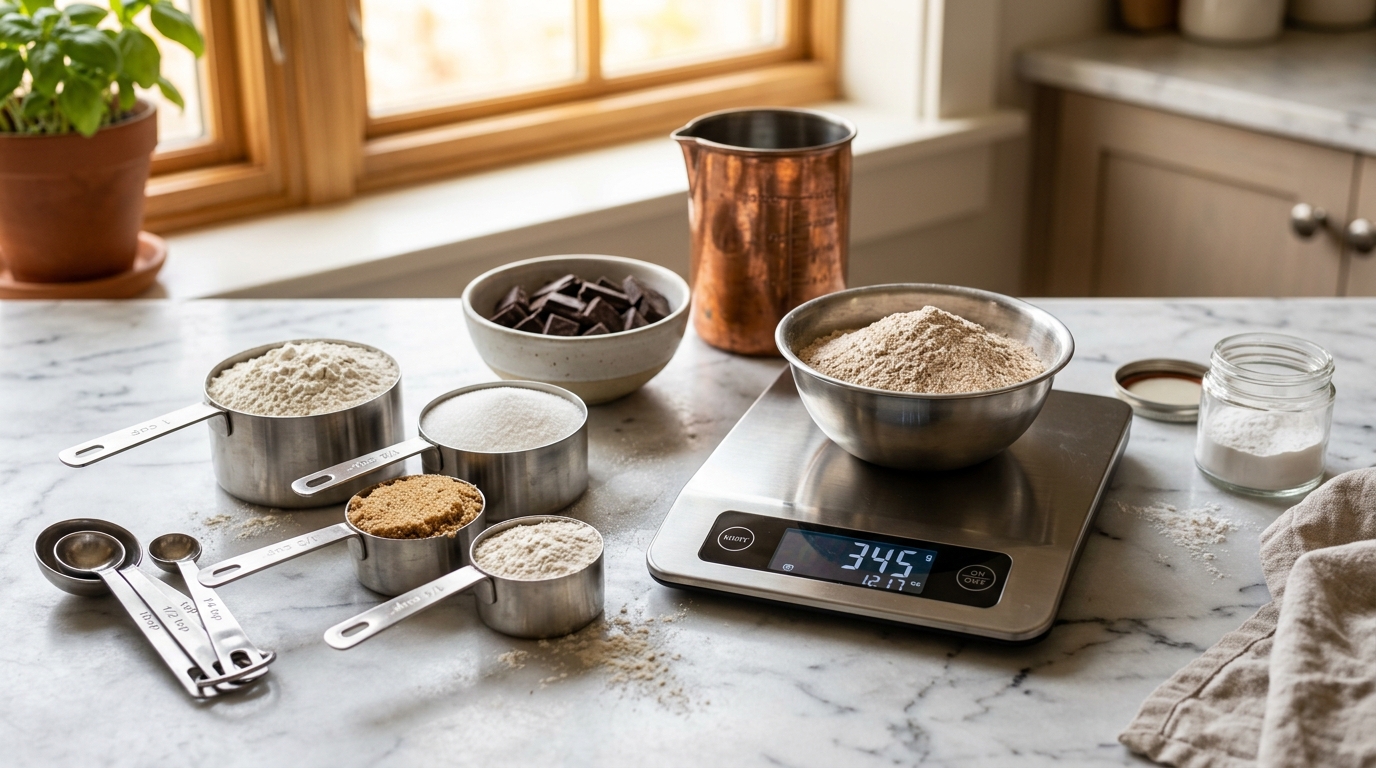
Culinary formulation represents another high-volume application where volume-to-weight conversions prove decisive. Traditional recipe frameworks quantify ingredients via cups, tablespoons, and teaspoons. However, dry ingredients such as flour and cocoa powder exhibit erratic bulk densities depending on atmospheric humidity and packing pressure, introducing mass variations exceeding twenty percent per measured cup.
Modern professional bakeries and food science laboratories replace volumetric cups with precision gravimetric scales. Standardizing ingredient ratios in grams rather than fluid ounces eliminates packing density errors, ensuring consistent dough hydration, crumb structure, and thermal baking kinetics across commercial kitchen facilities. Food technologists in the culinary sector treat gravimetric measurement as the definitive standard for industrial scaling.
Pressure Effects and Bulk Modulus in Hydraulic Fluids
While liquids are treated as practically incompressible in low-pressure applications, extreme hydraulic pressures compress fluid volumes noticeably. The bulk modulus of elasticity measures a liquid's relative volume decrease under applied hydrostatic stress. In hydraulic systems operating at pressures above 350 bar (5,000 psi), mineral oil compresses by roughly two percent, storing significant elastic energy that affects servo-valve response times.
Mechanical design engineers account for fluid compressibility when sizing hydraulic accumulators and high-pressure injection manifolds. For comprehensive explanations of high-pressure fluid measurement units including bars, megapascals, and pounds per square inch, explore our industrial pressure standards guide. Integrating volume, temperature, and pressure metrology provides complete physical control over complex fluid delivery operations.
Authoritative Metrological Standards Cited
All unit ratios, physical constants, and dimensional formulas in this paper are verified against official international standards repositories.